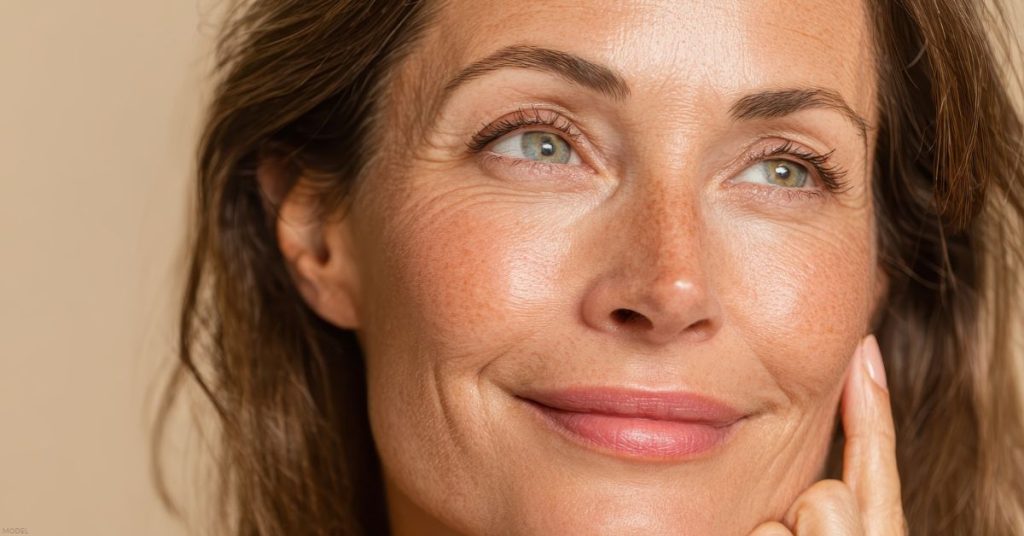
If your face looks thinner or more tired than you feel, the change may involve lost volume. Temples can become hollow, under-eye shadows more noticeable, and the lower face less supported. Aging and significant weight loss can both contribute.
Facial fat transfer, also called autologous fat grafting, uses a small amount of your own body fat to restore selected areas of facial fullness. At Highlander Dermatology & Aesthetic Center in Brookfield, Wisconsin, Dr. Kristina Kleven approaches treatment with a focus on proportion, balance, and results that still look like you.
What is Pan-Facial Fat Grafting?
“Pan-facial” means considering the face as a whole. Rather than focusing on one crease, Dr. Kleven evaluates how the temples, cheeks, under-eye area, and lower face relate to one another. Treatment is then tailored to the areas where added volume could help. It does not mean every area needs an injection.
Depending on your anatomy, facial fat grafting may address:
- Hollow temples that make the upper face appear narrower.
- Cheek volume loss that changes facial contours.
- Selected tear-trough or under-eye hollows.
- Volume loss around the mouth, chin, or lower face.
Under-eye treatment requires particular care. Bags, pigmentation, and loose skin can create concerns that adding volume alone will not resolve. We often combine fat transfer with other procedures during the same treatment to address these concerns and create a more balanced result.
For the upper face, brow recontouring can refine its shape. This complements volume restoration as part of a full facial treatment plan.
Can Fat Transfer Help After GLP-1 Weight Loss?
Facial volume loss can occur after substantial weight loss, including weight loss with GLP-1 medications such as semaglutide or tirzepatide. Sometimes called “Ozempic face,” these changes are not unique to one medication. Rapid or significant weight loss from other causes can also leave cheeks or temples looking less full.
Fat transfer is an excellent option when there is visibly lost volume with fat loss. Timing matters: continued weight loss can alter the result, so a reasonably stable weight is an important part of planning.
How Does Facial Fat Transfer Work?
The procedure has three main steps:
- Harvesting: A small amount of fat is removed from a suitable donor area, often the abdomen or thighs, using liposuction.
- Preparation: The collected tissue is processed to prepare it for transfer.
- Placement: Small amounts are carefully placed into selected facial areas.
The consultation covers your treatment plan, anesthesia, donor site, and recovery.
Why Choose Your Own Fat for Facial Volume?
For someone with volume loss across several areas, fat grafting offers the possibility of restoring soft fullness using their own tissue. Fat that survives the transfer can provide lasting volume.
Some patients prefer using their own fat to restore fullness in several areas during one procedure.
Dermal fillers remain useful options, particularly for smaller corrections or patients who prefer less downtime. A consultation can help you compare the trade-offs.
Experience, Anatomy, and a Conservative Approach
Dr. Kleven is a board-certified dermatologist with more than 20 years in practice and experience in dermal fillers, liposuction, and cosmetic facial treatments. Her background in art and painting also informs her attention to proportion and subtle changes.
Dr. Kleven has attended the hands-on Fat Transfer Workshop at the American Society for Dermatologic Surgery, directed by the ‘godmother’ of fat grafting, Kimberly J. Butterwick, MD, and Lisa M. Donofrio, MD. This focused training complements her experience with facial volumization and her commitment to continuing education.
Facial volumization requires deciding where to add fullness and where to leave things alone. The goal is to restore balance while respecting your features, expressions, and preferences. Bringing older photographs can help explain what has changed and what you hope to restore.
How Long Does Facial Fat Transfer Last?
Some transferred fat is naturally reabsorbed during healing, and no specific retained amount can be guaranteed.
Fat that survives and establishes a blood supply can remain for many years, potentially for life. However, your face continues to age, and the transferred tissue can change with weight gain or loss. A second treatment may be needed to achieve the desired correction. The result becomes clearer over several months as swelling settles and the transferred fat stabilizes.
What Should I Expect During Recovery?
Expect swelling, bruising, and tenderness in the face and donor area. Many patients plan roughly one to two weeks away from public-facing activities, although some need much less and occasionally longer. Subtle swelling can persist beyond that period.
Your individual instructions will cover activity restrictions, skin care, donor-site care, and follow-up.
Am I a Good Candidate?
Candidates generally have facial volume loss, stable weight, and health that supports healing. Nicotine use and certain medical conditions can affect candidacy. Significant loose skin may need a different or combined approach.
Explore Facial Fat Transfer in Brookfield
Ready to restore the fullness that helps you look as vibrant as you feel? Schedule a facial fat transfer consultation with Dr. Kristina Kleven at Highlander Dermatology & Aesthetic Center in Brookfield, near Milwaukee. She’ll listen to your goals and create a personalized plan to restore natural-looking volume and balance, while keeping you looking like you.
Learn more about Dr. Kleven and our team, then contact us to schedule. Our Brookfield office is located at 16650 West Bluemound Road. Call (262) 406-1869 or text 262-204-5512 to book your appointment.